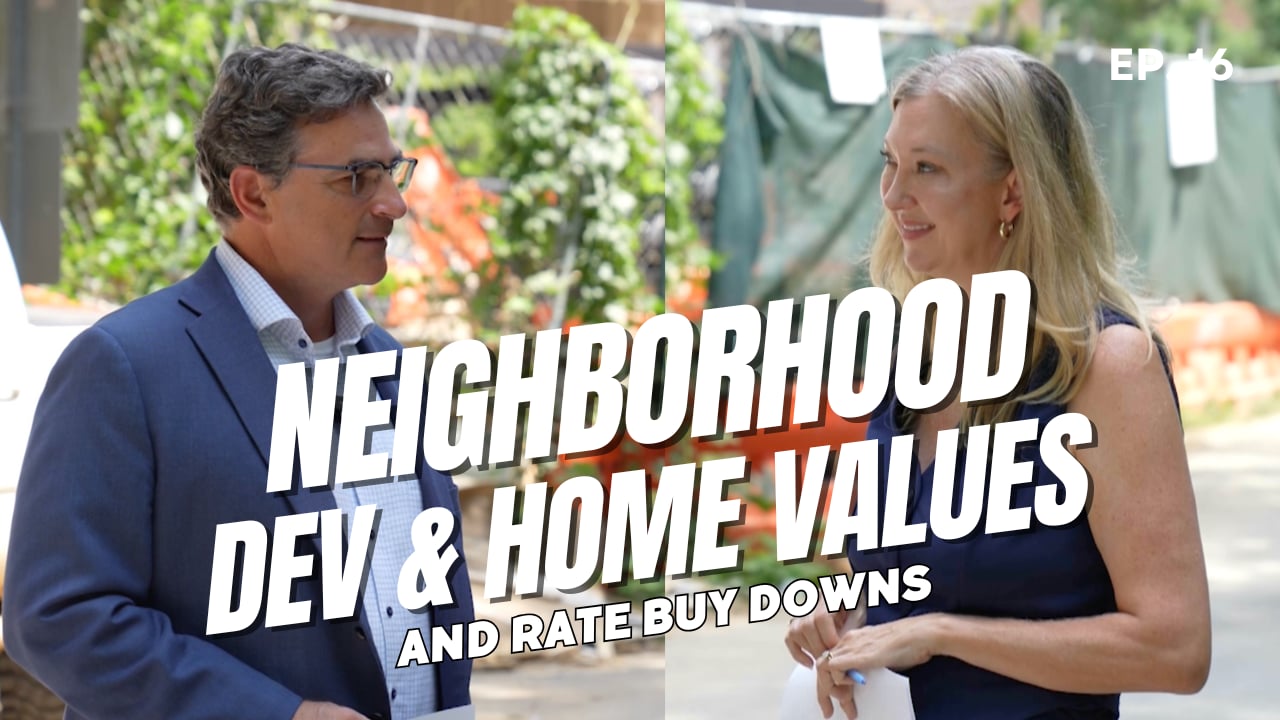
Atlanta and its surrounding neighborhoods are experiencing a powerful wave of growth, and Episode 16 of How to Sell Your Atlanta Home with Sage and Grace gives home sellers the inside track on how to leverage it. Host Judy Jernigan brings together two experts to break down how new development, economic expansion, walkability, and strategic mortgage tools influence home values across Brookhaven, Buckhead, Sandy Springs, Chamblee, and greater North Atlanta.
This episode blends big-picture economic insight with practical, actionable strategies that help home sellers stand out in today’s market.
Guest Geoff Smith, a mortgage advisor and local economic development expert, explains how factors like walkability, retail access, and major commercial investments influence property demand.
Listeners learn how Brookhaven’s rapid growth, new mixed-use projects, zoning updates, and increased neighborhood connectivity drive both livability and equity for homeowners.
Key takeaways:
Walkable communities attract more homebuyers and support higher resale values.
Neighborhood retail and amenities directly influence buyer demand.
City planning decisions create long-term stability for property ROI.
Sellers who understand development trends can time the market more strategically.
Guest Martene Nadeau breaks down temporary and permanent rate buydown strategies and how they help home sellers attract a wider pool of homebuyers without reducing price.
Inside the episode, listeners learn:
What a 3-2-1 buydown is and when it makes sense.
How seller-paid incentives reduce buyer hesitation around rates.
The true cost of a 0.25 percent buydown at different price points.
How to position a buydown inside a listing to strengthen offer terms.
When to offer rate credits and how to estimate the potential value.
These tools help home sellers protect their list price while still improving affordability for homebuyers.
Selling a home in Atlanta today means understanding two major drivers of buyer demand:
1. Location advantages amplified by development, walkability, and retail growth.
2. Financing strategies that make your home more appealing without reducing price.
Episode 16 gives home sellers both the economic context and the strategic tools needed to create stronger listings, attract more homebuyers, and sell with confidence.
Senior Loan Officer, Assurance Financial
Expert in economic development, home values, and the mortgage landscape.
Website: https://assurancemortgage.com/assurance_officers/geoff-smith/
Mortgage Loan Officer
Specialist in temporary buydowns, seller credits, and financing solutions for homebuyers and home sellers.
Instagram: https://www.instagram.com/martene_nadeau_nmls_1145632/
To help listeners dive deeper, here are related blogs and episodes from SageAndGraceRE.com and your YouTube channel:
Episode 6: How Craftsmanship and Renovation Strategy Increase Home Value
Episode 2: How to Buy and Sell at the Same Time with Derek White
These resources reinforce the themes of development, strategy, buyer behavior, and maximizing equity.
Sell your Atlanta home faster, with a clear strategy and world-class service.
Website: https://sageandgracere.com
Get Your Home Valuation: https://sageandgracere.com/home-valuation
LinkedIn: https://www.linkedin.com/in/judyjernigan
Instagram: https://www.instagram.com/sageandgracerealty
Facebook: https://www.facebook.com/sageandgracerealty
Schedule a Consultation or Book a Chat: https://calendly.com/judyjernigan
Transcript

[Judy]
Join us on the next episode of how to sell your Atlanta home with Sage and Grace, smart homeowner strategies, successful real estate sales. As we dive into the dynamic developments around the Dresden Drive area in Brookhaven and North Atlanta, with our special guest, Jeff Smith. Discover how these new developments can impact your home selling strategy and impact neighborhood property values.

Selling a home isn't just about putting up a for sale sign. It's about strategy, marketing, and negotiation. But how do you know if you're making the right moves?

I'm Judy Jernigan, recognized among the top 5% by the Atlanta Realtors and your host of how to sell your Atlanta home with Sage and Grace, smart homeowner strategies, successful real estate sales. With a background in broadcasting, negotiation, and education, I bring a unique perspective to home sales, helping homeowners sell faster for top dollar and with less hassle while understanding not just the financial side, but also the logistical and emotional considerations of a move. This show helps you plan ahead, navigate the market, and work more effectively with a realtor like me.

You'll get expert insights from my guests, plus real actionable strategies to sell with confidence. Now, here's the show, moving you forward with Sage advice and grace. I'm Judy Jernigan, founder of Sage and Grace Realty Group, licensed broker in North Carolina and Georgia.

Today, we are thrilled to welcome Jeff Smith, branch manager at Assurance Financial's Roswell, Georgia branch. With a strong passion for community and extensive experience in the mortgage industry, Jeff is an advocate for vibrant, thriving communities. He also has a background in news reporting.

[Geoff]
I do. Thank you so much for having me. It's a pleasure and an honor to be here.

I do have a little bit of a background. That's why Judy got me involved here. We've worked together on some deals and used to cover news and economic development.

I'm kind of an economic development junkie here in the Atlanta area. I've been writing a column on it for 30 years. I really enjoy it and I pay attention to it.

Here in Brookhaven, we're in one of the most up and coming progressive communities in the Atlanta area. There's a lot of potential here and there's a lot that's going on in Brookhaven. Brookhaven's really not that old of a city.

Established in 2012. There's about 59,000 people here, runs from Atlanta all the way up to 285. So it can claim a lot of in-town stuff and it also can claim a lot of suburban stuff up in Dunwoody.

And it can claim just about everything in between along Beaufort Highway, which is one of the most exciting foodie kind of capitals in the Atlanta area. A lot of cool people have been there, including Anthony Bourdain, have blessed the city with their presence there on Beaufort Highway. And Beaufort Highway, speaking of opportunity, there's a ton of opportunity going on in Beaufort Highway and the city is very well aware of that.

There's a lot of incentives right now. There's a lot the city's doing to plan and try to both preserve the culture that has made Beaufort Highway such an iconic street here in the metro Atlanta area, but also encourage new development that is sorely needed around that area. It'll be interesting to watch how Beaufort Highway develops throughout the course of just really the next five to 10 years.

[Judy]
So Beaufort Highway is one of the treasures of Atlanta. When I think of living here and wanting to take advantage of the opportunities that come with living in such a big city, that's one of the things I think of is going there and trying different foods from all over the world. And do you have a favorite food, international food, if you were going to go seek something out?

[Geoff]
I really, really love Spanish cuisine and Mexican food and South American food. I love that and I love that they have a ton of it up and down Beaufort Highway. But we've gone there, Brenda and I have gone there for all kinds of different food because there's such a huge variety and it is so authentic.

[Judy]
Yes. For me, it's dim sum.

[Geoff]
Oh, awesome.

[Judy]
Something I did not grow up eating. It's something I discovered later in my more adult life and I just, yeah, I love dim sum. And it's a place where you can go get, as you said, really authentic, I think.

[Geoff]
Absolutely. And if you haven't been down Beaufort Highway and you're just looking for an adventure, go out on Beaufort Highway, just pick a restaurant and just go get something truly authentic and truly unique that you cannot find in your hometown.

[Judy]
So behind us is the Parkside on Dresden community that is being built. This is a mixed-use community. It has condos on the top floors.

There's going to be retail establishments, restaurants, shops, other stores on the ground level. And then some townhomes in the back that are going to be available for rent once the development is complete. In this area and other areas that you have followed, how does development like this impact a community and property values?

[Geoff]
Well, it's bringing people and residents into an area. And when you have residents, you can then support retail. And so that's a lot of stuff that you're starting to see pop up.

There's a lot of communities that want all the retail, but you have to have the people there to support it. And one of the great things about Brookhaven is there's a lot of people working in Brookhaven, so you get some of that daytime traffic as well. And then there's a lot of residents in Brookhaven.

So you're looking for those kind of retail that can support it. And I think this, if I'm not mistaken, there's a retail component to these apartments and townhomes right behind us.

[Judy]
Right, yeah, the whole lower level is going to be some restaurants, some shops, some businesses will have their offices there too. So I have read a report recently that said that millennials, especially, really enjoy communal spaces. And it's something that they put a value in.

They want to live near spaces where they can get together with their friends.

[Geoff]
Absolutely, and if you think of the millennial workforce has really just changed how big businesses think about where to locate their corporations, for example. It has changed everything. Up in Alpharetta, for example, where you have these huge campuses, these huge corporate campuses, they're grappling with how to deal with this millennial workforce where they want to be able to walk out of their building and go get something to eat.

They want to be able to walk out of their homes and go to places. They don't like getting in the car, and who can blame them? Atlanta is not known for its easy traffic, right?

Who can blame them for that? You're seeing a lot of changes in the work world to go with this mentality of and this lifestyle of people wanting to just be able to walk out their door and go get something to eat. And how better right here to live right here and just walk right downstairs and here you've got, it looks like it's going to be about three or four different restaurants to choose from, not to mention the development that's already here.

[Judy]
Right. We're right between condos, there's townhomes, and there's residential single-family homes as well, all within a stone's throw of this area. I feel, and I'd love your input on, I think development such as the one behind us bringing in more shopping, dining businesses is going to elevate property values in that it's going to increase demand and people are going to like living next to these cool new spaces.

[Geoff]
Oh, absolutely. There's no doubt about it. They've got to draw, right?

When you can be close to something, you're all of a sudden in demand and that's proven anywhere across the whole Atlanta. If you look at the Beltline, for example, right? As soon as they built the Beltline, property values around that Beltline went up dramatically.

All of a sudden, developers wanted to come in and get commercial and restaurants and all that kind of stuff along it because it had such a cool factor of something to do to be close to it. So anytime you can add something within a walkable distance in the Atlanta area, that product is going to be in demand. No doubt about it.

[Judy]
I was speaking with a neighbor of mine last summer. We got a coffee shop within walking distance of the street we're on and she said that just increased my property value. Being able to walk to a coffee shop, I was like, yeah, I bet you're right.

What are some common misconceptions that homeowners may have about potentially selling their homes in rapidly developing areas like this?

[Geoff]
Well, I'm not sure. A lot of people might start to get crowded out. Some people don't enjoy this.

People who have been living here for a long, long time may not enjoy the new development. I grew up in Roswell and Roswell has grown up a lot. I like to say I'm from the city everybody was moving to instead of moving from.

But some people liked having their country spaces, so to speak. And some people just don't like change, period. And so that is something that every city leader has to grapple with as you grapple with developing but not getting rid of that charm that made your place such an attractive place to live in in the first place.

[Judy]
Right, yeah. From a home selling standpoint and the marketing enlisting in this area, again, being able to have nearby shopping, dining, and other businesses. I believe there's a pet care place that's coming into the build right behind us.

It's something that is going to be appealing to a lot of homebuyers right now. So it is going to increase property values. But there are some homeowners who may not like all the construction and the noise and the added congestion.

[Geoff]
Construction noise. And you start thinking about property taxes also. I know people who have been living here for a while start worrying if you say property values go up, they think taxes go up too.

But in places like Brookhaven, there's a lot of stuff that's built in to help curb some of the property taxes rising too fast on somebody. But that is an argument I hear also for people who have been living here a while and are maybe on a fixed income.

[Judy]
That is a good point. As you, in your experiences studying urban development, how important do you think walkability is?

[Geoff]
I think right now it's the thing in metro Atlanta area, and that's not just in Brookhaven, that's all the way out into the suburbs. Everybody's trying to put in more walkable environments. When I was growing up in Roswell, for example, there was not much to do.

You had to get in your car, you had to drive to the strip mall, and then you drove home. If you really wanted some entertainment, you would drive all the way down 400, all the way into Atlanta, park, go to the Fox Theater, and then drive all the way back. Now every downtown is working so hard.

Every suburban city is working hard to create a downtown, an environment where there's things to do. And it's really just in the last 20 years, the explosion of all the little cities around Atlanta and all the towns has been amazing. I mean, you don't have to leave your little city anymore to go get entertained.

There's a lot of people who are just maturing as a city here in the metro Atlanta area, and it's just become such a cool place to live. The businesses used to move here because of the low cost of living. They could pay their employees less because it costs less to live here.

Well, the cost of living is going up, but now we can sell the quality of life because quality of life everywhere around the metro Atlanta area has become so strong. Every community now has its own personality, has its own little parks, has its own distinct thing of what's going on and makes it unique. And I have friends that will just go from one suburban downtown to another every single weekend, right?

Because there's so many things to do and concerts and all kinds of stuff. And just finding a little pocket like this, like this right here with their little host of neighborhoods, it's got its own ecology and ecosystem there. It's just a lot of fun.

It's a lot of fun to watch Atlanta grow like this.

[Judy]
I'm so glad you mentioned how there's different communities and they each have a different vibe or different feel. That's part of the value I bring to a homebuyer relocating to this area is helping them figure out which neighborhood is going to be the best fit for them, which vibe. I had a client a few years ago say, oh, I visited my son and I just don't like Atlanta.

And I was like, you just that's too broad of a statement. What parts did you visit? Let me show you some different parts.

We're a big city. There's different vibes in different areas, different things to enjoy. And that's something that I do.

I get to know my clients and what they like to do in their spare time and what's important to them and can help them narrow in on the neighborhood. Maybe it's this one. Maybe it's a different one.

That's going to be a good fit for them and their families.

[Geoff]
And that is critical. Every single buyer is different. Right.

As you well know, you're one of the best in the business when it comes to figuring out a personality, figuring out where they're going to fit. I've always said to people, you can find the perfect house, but you have no idea what's going on around you. Like you can't find the right neighbors.

Right. You don't know what you're going to get. But knowing the communities, knowing what's going on around you, you've always impressed me.

And the fact that you've gotten you've been able to marry people's personalities almost perfectly with the houses and the communities that they end up in. And it's an art. It is an art.

And I've always appreciated watching you work your magic that way.

[Judy]
Oh, you're kind. Thank you. Thank you.

Where can we find you online?

[Geoff]
So you can find me at AssuranceMortgage.com. You can look up Jeff Smith and that's Jeff with a G, G-E-O-F-F. I always tell realtors and people and my homebuyers when y'all are working, I'm working.

So you can call me in the evenings, the weekends. I know that y'all have a day job so that you can afford getting this mortgage in this new house. And so even after work or on the weekends, I'm always available to make sure that you're comfortable and understanding the numbers and finding the just the right product for you.

[Judy]
I'm Judy with Sage & Grace Realty Group. We're unlocking the secrets to selling your Atlanta home with confidence and clarity. Join me on our smart homeowner strategies for successful real estate sales series.

We'll see you next time. Homes are sitting on the market a little bit longer right now than we've seen in years past. And home sellers are offering incentives to homebuyers to help get their homes under contract more quickly.

One of the incentives we've been hearing a lot about are called rate buydowns. What is a rate buydown and how much does it cost if a home seller wants to offer this to a potential homebuyer? Today, I'm joined by Martine Nadeau.

So Martine, what is a rate buydown?

[Martene]
A rate buydown is when you want to get your rate from one point, like the starting point. So let's say it's at 6.75, but you want your payment to be lowered. So you want to buy the rate down to maybe 6.5, 6.25, even maybe under 6%. That way you can manage your payments, monthly payments. And then with the rate buydown, you're paying that cost for that rate for the duration of your loan up front.

[Judy]
Okay, so big picture. We're talking about the homebuyer has talked with a mortgage professional, and they have figured out based on their personal situation, their debt-to-income ratio, how much of a down payment they have saved, their credit score is a big one. They know what interest rate they qualify for, and the rate buydown is going to help them lower that interest rate, right?

Right. So the home seller can help pay for that. So can you give us an example?

Maybe we come up with a pretend homebuyer and their situation, and how much it would cost for the home seller to buy down the rate. Like how much money are we talking about here?

[Martene]
Right, so again, it depends on your credit score, the price of the house, those kinds of things. So I'm helping a customer currently, and their mortgage is right about $800,000. They're going to put 30% down, and so that's where we got to the $800,000.

So their rate buydown, if they want to go quarter of a rate, and that price range is going to be about $10,000. So a quarter of a percentage? Right, a quarter of a percentage.

So they would go from 6.75 to 650, roughly. And then if they want, we also talk about going down to 6.25 from the 6.75, and that is about $13,000. So the seller can contribute on a conventional loan up to 6% of the loan amount.

[Judy]
If the homebuyer is putting 20% down. Right. A home seller can contribute 6% of the loan amount.

So they can use, how much did you say, for a quarter of the interest rate?

[Martene]
So normally it's $10,000, depending on the price of the home. Or if you go down to like $300,000, it might only cost $5,000. It also depends on what the market and the mortgage rate looks like because those adjustments are made as the rates adjustments are made as well.

[Judy]
This is something a home seller and their realtor could get with you and talk about, here's the price point of the home. If we get a potential homebuyer that comes along that is planning to put, let's say, 10% down, we want to offer a rate buydown up front. How much money are we talking about?

That's something you could help us crunch the numbers and give the home seller a feel for how much money they're offering.

[Martene]
That's exactly right. When you get a feel of how you're going to price the house, and then the buyer is going to figure out how much house they can afford. Again, that makes their monthly payment lower with the rate buydown.

The seller would be paying the buyer to have that rate buydown one-time cost up front.

[Judy]
For an $800,000 home and someone who's a homebuyer putting 20% down, roughly $10,000 from the seller would help them lower their interest rate by a quarter percent. Right, and that's today.

[Martene]
That's today, right?

[Judy]
It could always change.

[Martene]
It could be a little bit less or it could be a little bit higher just depending on where the mortgage rates fall.

[Judy]
To give people a ballpark.

[Martene]
Yeah, a ballpark figure, yeah, I would probably say around that $10,000.

[Judy]
In the marketing, the home seller and their agent could say we're offering $10,000 for a rate to use towards a rate buydown. Of course, everything is negotiable. The homebuyer could use that $10,000 credit, if you will, however they want to structure it.

What is a 3-2-1 buydown?

[Martene]
3-2-1 buydown is how you pay the rate from the third year to the second year to the first year before you go into your locked-in rate. It's going to be a little bit less three years out than two years and then one year. That costs a little bit higher because you're getting a substantial lower rate for the first three years, and then you lock your rate in after that time.

[Judy]
Is it a full percentage point on year three? I guess it varies.

[Martene]
It would vary. It would vary depending, again, on how much you want to buy down, where the rates are when you try to do the buydown, and then how much you're willing to spend.

[Judy]
On the first year, your rate is going to be a lot less. Year two, your rate is going to be a little bit higher. The next year, your rate is going to be a little bit higher, and then after three years, your rate is going to be whatever it would have been without the buydown.

I think the idea is that should interest rates come down in that first three years, you can always do a refinance.

[Martene]
Yeah, you can do a refinance without any cash out of your pocket. We talk to people about this all the time, not to worry technically about the rate because you're not stuck with the rate, right? And so we can do that refi without any cash out of your pocket.

Hopefully, you have a little bit of equity in your house at that point. If you needed cash back to pay some debt off, you can do that too. So that's kind of where when we talk about rate, we try not to get people to get caught up in that rate because you're really technically not going to have it for the 30 years.

[Judy]
So when interest rates are a little bit higher or homebuyers feel like they're higher, even though historically, traditionally speaking, they may not be, but after coming out of the pandemic years where we saw rates that were probably never going to see that low again, some people still are having some sticker shock. This is something home sellers can do to market their home and help homebuyers make it happen, right, and attract homebuyers.

[Martene]
To attract the homebuyer, and it also helps the homebuyer maybe buy the house that they want, but the rate was holding them back. So the price point might be a little bit higher than they typically would have looked at.

[Judy]
I love that. So it can be a good idea to consider in your marketing plan.

[Martene]
Yep. Where can people find you? So I'm Martine Nadeau.

I'm located in Atlanta. My work number is 678-447-7888. Perfect.

Thank you. You're welcome.

[Judy]
Thanks for joining us on How to Sell Your Atlanta Home with Sage and Grace. I'm Judy Jernigan, and I love helping homeowners sell smarter with less stress and better results. Who do you know with real estate questions?

Please connect us so we can make confident, well-informed decisions and get the best possible outcomes together. If you enjoyed this episode, be sure to like, subscribe, and leave a five-star review. It helps more homeowners get the smart strategies they need for a successful sale.

Head to sageandgracere.com to learn more about working with me and the Sage and Grace real estate team. Explore all our show episodes. And when you're ready, book a chat directly with me, Judy Jernigan, moving you forward with Sage advice and grace.